
Blog navigation
Latest posts
When is a nut actually a nut?
3901 views 14 Liked

When is a nut actually a nut? An almond is sometimes called a fruit, a hazelnut is botanically a true nut, while a...

Read more
From Bombay Nut to West African Cashew
2980 views 23 Liked

From Bombay nut to West African cashew.Discover how the cashew trade evolved from India and Vietnam to Africa, and...

Read more
Healthy office snacking: why 30 g of nuts makes the difference
818 views 17 Liked

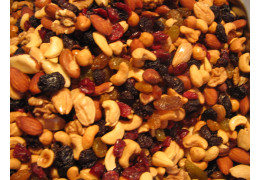
Healthy office snacking starts with the right choice. Our 30 g portion packs of nuts provide long-lasting energy, are...
Read more
Nuts & Daily Nutrition: What You Need to Know
592 views 8 Liked

Nuts are versatile, nutritious and easy to combine. Learn more about different types of nuts, roasting, portion size...

Read more
Why are our nuts so affordable?
457 views 12 Liked

Why are our nuts so affordable? Discover how simple packaging, efficient processes and premium-quality nuts result in...

Read more

When is a nut actually a nut?

3903 Views 14 Liked
 

I regularly read that, botanically speaking, an almond is not a true nut but a fruit or stone fruit. Sometimes this is even simplified to: “An almond is actually a fruit.”

That made me stop and think.

I have worked with nuts for many years, and I began to wonder: is that really right? Not necessarily according to the official botanical classification, but simply from a logical point of view.

Because the almond we eat is not the fruit of the almond tree at all. It is the seed inside that fruit.

Almond, Brazil nut, cashew, hazelnut and peanut explained

Almond, apricot and cherry

Take an almond and an apricot.

They are actually related. Both belong to the genus Prunus, along with peaches, plums and cherries.

With an apricot, we eat the flesh and usually throw away the hard stone. Inside that stone is the seed.

With an almond, essentially the same thing happens, except that we do not eat the flesh. The outer fruit dries out, the hard stone is cracked open, and we eat the seed inside.

We call that seed an almond.

Why should that seed suddenly become fruit simply because the flesh around it is thin, dry or not interesting to eat?

The fruit is the fruit and the seed is the seed.

Take a look at a Brazil nut

With a Brazil nut, the difference may become even clearer.

A large, hard fruit grows on the Brazil nut tree. Inside that single fruit are several seeds together.

We remove those seeds and sell them individually as Brazil nuts.

So when someone holds a single Brazil nut in their hand, they are not holding the fruit of the Brazil nut tree. They are holding one of the seeds from inside that fruit.

Yet we call it a nut.

And then there is the cashew

The cashew makes the story even more interesting.

The distinctive cashew apple develops on the tree, with the structure containing the cashew seed growing beneath it. After processing, that seed is what we know as the cashew nut.

The structure of the fruit is completely different from that of an almond, Brazil nut or hazelnut.

But once again, what we ultimately eat is the seed.

The hazelnut happens to qualify

Then we have the hazelnut.

It does meet the botanical definition of a true nut. Botanically speaking, a nut is a particular type of dry fruit with a hard fruit wall.

And I think that is exactly where the confusion begins.

The botanical definition is primarily intended to describe how a fruit is structured.

But when we talk about a nut in a shop, in the kitchen or in the nut trade, we are usually talking about what we eat from that fruit: the seed.

These are really two different ways of looking at the same product.

And what about the peanut?

The peanut makes the discussion even more interesting.

In everyday language, we often call it a nut. Yet it grows in a completely different way.

The peanut plant is a herbaceous legume. After fertilisation, a specialised fruit stalk grows down into the soil. Underground, the pod develops with the peanut seeds inside.

So the peanut is not the seed of a tree or tree-like shrub.

And according to my own definition, that means it does not belong among the nuts.

Perhaps it can be much simpler

The longer I thought about it, the more I wondered why we make the definition of a nut so complicated.

For me, it can be simpler:

A nut is the seed of a tree or tree-like shrub. Edible or not.

Whether that seed is surrounded by juicy fruit, dry fruit, a hard shell or a completely different structure does not change what the seed itself is.

That does not mean I believe the botanical classification is wrong. It has a scientific purpose and describes how different types of fruit are structured.

But perhaps we are trying to answer two different questions with the same word.

The botanist asks:

What type of fruit is this?

I ask a different question:

What is the seed that can ultimately produce a new tree or shrub?

And from that perspective, I arrive at my own definition of a nut.

Perhaps my definition is not the official botanical one.

But is it really any less logical?

What do you think?

When is a nut a nut?

 
Was this blog post helpful to you?
Posted in: Behind the scenes
Leave a comment
★
★
★
★
★
Security code